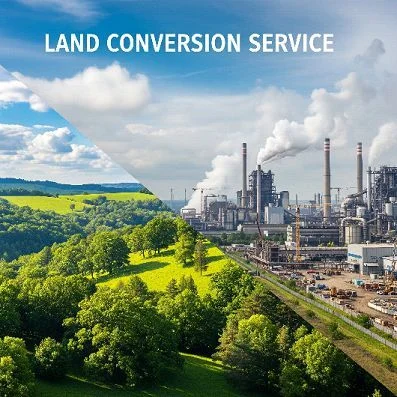
Converting agricultural land for industrial use is not just a change in the land record. It requires the proposed industrial use to fit the applicable planning, revenue, access, infrastructure and environmental framework. TANVI Consultancy helps organise the case from the first land-record review through application coordination and post-approval follow-up.
Agricultural land cannot automatically be used for a factory, workshop, processing unit, warehouse or other industrial purpose. The land-use position has to be checked against the Maharashtra Land Revenue Code, the applicable Development Plan or Regional Plan, and any project-specific approvals.
For an industrial proposal, the review normally goes beyond ownership records. Road access, zoning, acquisition status, water availability, drainage and sewage arrangements, pollution-control requirements and conditions attached to the land can all affect whether the proposal can move forward.
A strong Industrial N.A. case begins by checking whether the land and the proposed activity are compatible before preparing a large document set.
Review 7/12, 8-A, mutation entries, tenure conditions, other-rights entries, revenue dues and ownership continuity.
Confirm whether the proposed industrial use is consistent with the applicable Development Plan, Regional Plan or planning authority rules.
Check approach road, right-of-way documents, highway/PWD implications and whether the site has lawful access suitable for the proposal.
Industrial proposals may need credible arrangements for water supply, sewage, storm water, effluent and other basic infrastructure.
Forest, eco-sensitive, acquisition, reservation, coastal or other restricted conditions can change the approval path or require additional clearances.
For industrial use, pollution-control requirements may need to be considered alongside the land conversion and development approvals.
The exact authority and sequence can vary with the district, planning jurisdiction and nature of the land. TANVI Consultancy structures the work around the actual case rather than using a one-size-fits-all checklist.
Section 42 deals with use of agricultural land for non-agricultural purposes. Section 44 contains the traditional application framework for conversion/use-change cases. Later provisions and planning-area mechanisms may alter the route in specific locations.
Official Maharashtra textCollect and review ownership records, 7/12, 8-A, mutation history, tenure restrictions, tax/revenue status and other-rights entries.
Match the intended industrial activity with zoning, site access, reservations, planning controls and project constraints.
Organise measurement plans, site/location plans, layout drawings, internal roads, open spaces and other drawings applicable to the proposal.
Identify the NOCs actually required for the parcel—for example local authority, road authority, acquisition, planning or environmental interfaces.
Prepare the prescribed proposal with the land details, proposed industrial use, supporting records and declarations required for the applicable route.
Coordinate filing, site verification, scrutiny and responses to queries or deficiencies raised during examination.
Applicable government assessment, conversion charges, premium or other statutory amounts are determined case-by-case by the competent authority.
After approval, coordinate the next record-related steps, mutation/remarks and compliance with conditions attached to the industrial-use permission.
Not every document below applies to every parcel. The final checklist should be created only after reviewing the survey number, tenure, zoning and proposed industrial activity.
An industrial site may ultimately need planning permission, building permission, factory-related approvals, MPCB consent, water permissions and utility infrastructure. A land conversion should therefore be approached with the intended project in mind—not as an isolated revenue-office exercise.
Our role is to help bring land records, drawings, required NOCs and the industrial-use proposal into one consistent case and coordinate the follow-up required for the applicable route.
Share the survey number, location, current land record and proposed industrial use. We can start with a practical requirement review.